

The Wonders of Myofascial Release Therapy Explained
Ever felt a deep, dull ache in your shoulder that won’t go away, no matter how much you stretch or massage it? Or maybe you’ve had tight hamstrings that refuse to loosen, even after weeks of yoga? You’re not alone. Millions of people live with this kind of persistent stiffness-not from injury, not from overtraining, but from something hidden beneath the skin: your fascia.
What Exactly Is Fascia?
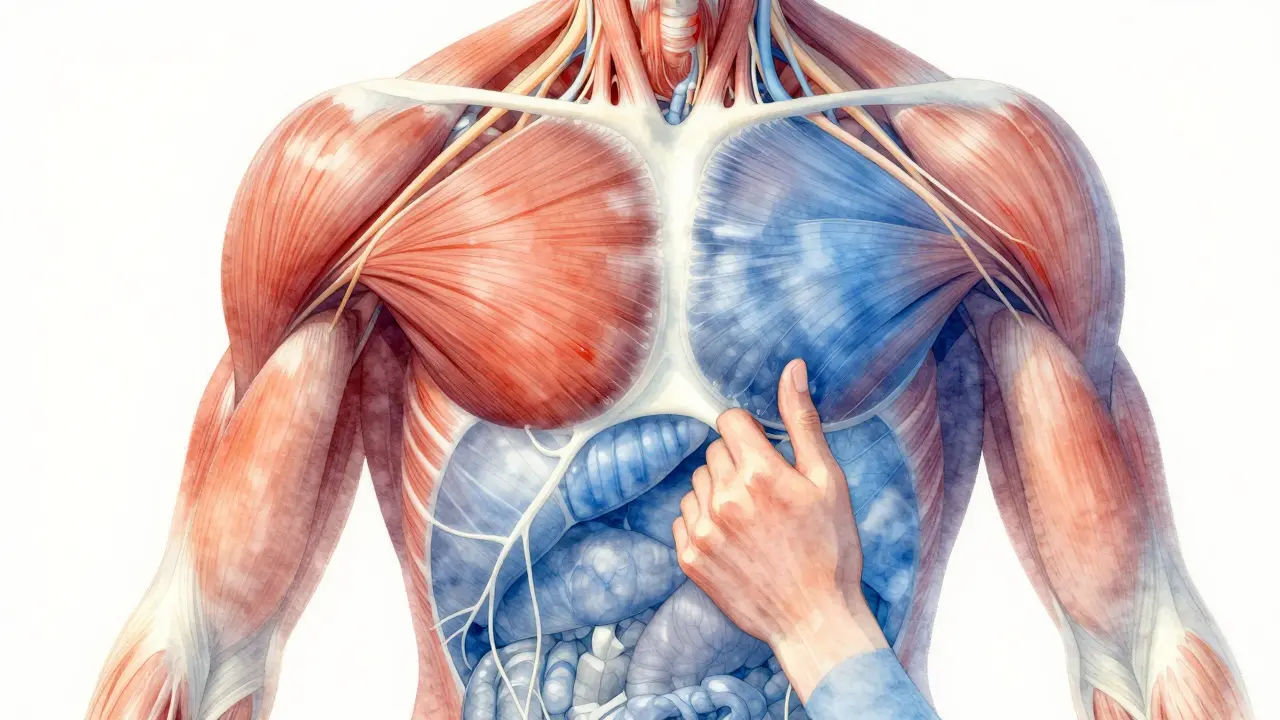
Fascia isn’t muscle. It’s not tendon. It’s not fat. It’s the invisible web that wraps around every muscle, bone, nerve, and organ in your body. Think of it like plastic wrap clinging tightly to a chicken breast-except in your body, it’s alive, stretchy, and full of nerves. When healthy, fascia glides smoothly, letting your muscles move freely. But when it gets stuck-because of injury, stress, poor posture, or even just sitting too long-it turns into a tight, sticky mess. That’s when pain starts.
That constant tension in your lower back? It might not be your spine. It could be your thoracolumbar fascia, pulling on your lower back muscles like a tangled rope. That headache you get every afternoon? Could be your cervical fascia tightening from hunching over your phone. Fascia doesn’t just connect parts-it transmits force, stores tension, and even sends pain signals. And when it’s stuck, your whole body feels it.
How Myofascial Release Therapy Works
Myofascial release therapy (MFR) is a hands-on technique designed to melt away those sticky spots in your fascia. Unlike regular massage, which focuses on muscles, MFR targets the connective tissue itself. Practitioners use slow, sustained pressure-often just the weight of their hands-on areas of tightness. No quick kneading. No cracking. Just gentle, patient pressure held for 90 seconds to five minutes.
Why so long? Because fascia is made of collagen and elastin fibers that behave like cold taffy. It takes time for the tissue to soften and release. You don’t “pop” it open-you gently encourage it to unwind. As the fascia loosens, blood flow returns, nerves stop being pinched, and pain begins to fade.
Studies from the Journal of Bodywork and Movement Therapies show that people with chronic low back pain who received just six sessions of MFR saw a 40% reduction in pain intensity. Another trial with fibromyalgia patients found improved mobility and sleep after eight weeks of weekly treatments. This isn’t placebo. It’s physics meeting biology.
What It Feels Like
People often expect MFR to hurt. It doesn’t. At least, not the way you think. There’s pressure-sometimes deep-but it should never feel sharp or unbearable. The best way to describe it? Like a slow, warm stretch that spreads through your body. You might feel a tingling, a buzzing, or even a sudden warmth in an area you didn’t know was tight. Some people cry. Not from pain-from release. Your body has been holding onto tension for years. When it finally lets go, the emotion comes with it.
After a session, you might feel a little sore, like after a good workout. But within 24 hours, most people notice something surprising: they stand taller. Their shoulders drop. Their breathing feels deeper. That’s not magic. That’s your fascia returning to its natural, relaxed state.
Who Benefits Most
MFR isn’t just for athletes or office workers. It helps anyone with persistent soft tissue pain. Here’s who sees the biggest results:
- People with chronic pain-like fibromyalgia, chronic headaches, or TMJ-often find relief where other treatments failed.
- Post-surgery patients-scar tissue binds fascia. MFR helps break that down without aggressive stretching.
- Recovering injury sufferers-after a car accident, fall, or sprain, fascia gets scarred. MFR restores movement.
- Those with repetitive strain-typists, musicians, builders-often have one-sided tightness that MFR can balance out.
- Older adults-as we age, fascia naturally stiffens. MFR keeps mobility alive longer.
It’s not a cure-all. If you have a herniated disc, severe osteoporosis, or an active infection, MFR isn’t safe. But for the vast majority of people with unexplained stiffness or pain, it’s one of the most effective tools available.
Can You Do It Yourself?
Yes-but with limits. You can’t reach every spot, and you can’t apply the same precision as a trained therapist. But you can use simple tools to get started.
A foam roller works for large areas like your back, thighs, or calves. Roll slowly-no bouncing. Pause on tender spots for 30 to 60 seconds until the discomfort drops by half. A tennis ball or lacrosse ball is better for smaller areas: your shoulder blade, the bottom of your foot, or your neck. Lie against the wall with the ball between you and the wall. Breathe. Let your weight sink in. Don’t push hard. Let gravity do the work.
But here’s the catch: self-treatment often misses the root cause. You might roll your IT band for weeks and still have knee pain because the real problem is your hip fascia. That’s why seeing a professional-even just once-is worth it. They’ll find the hidden knots you didn’t know existed.

What to Look for in a Therapist
Not every massage therapist does true MFR. Many mix it with Swedish massage or deep tissue work. Look for someone trained in John Barnes’ Myofascial Release Approach, the most widely recognized method. They’ll spend time talking to you about your history, not just jumping on the table.
Ask: “Do you use sustained pressure, not quick strokes?” “Do you work on one area for several minutes at a time?” If they say yes, you’re on the right track. Avoid anyone who promises instant results or uses cracking techniques. Real MFR is quiet, slow, and deeply personal.
What Happens After Treatment
Hydration matters. Fascia is 70% water. When it releases, toxins and metabolic waste get stirred up. Drink plenty of water for the next 24 hours. Avoid intense workouts. Your body needs to relearn how to move without tension. Light walking, gentle stretching, or a warm bath helps.
Most people need 3 to 8 sessions, spaced a week apart, to see lasting change. Some need more. But even after one session, many report feeling lighter, calmer, and more present in their bodies. That’s the wonder of MFR-it doesn’t just fix pain. It reconnects you to your own physical self.
Why It’s Different From Other Therapies
Chiropractic adjustments? They move bones. Physical therapy? It strengthens muscles. Massage? It relaxes muscle fibers. MFR works on the structure that holds everything together. It doesn’t fight the pain-it removes the tension that causes it.
Think of it like untangling a knotted headphone cord. You don’t yank it. You find the knot, hold it gently, and wait. That’s MFR. And once the knot’s gone, the cord flows freely again.



About Author

Popular Posts

Shiatsu Massage: Balancing Energy Naturally