

Finding Relief with Myofascial Release Therapy: How It Works and Who It Helps
Ever feel like your muscles are locked in a vice, even after a good stretch or massage? You’re not just tense-you might be dealing with tight fascia. Myofascial release therapy isn’t magic, but it’s one of the most effective ways to break through deep, stubborn pain that doesn’t respond to regular stretching or even chiropractic adjustments. Unlike a standard massage that works on muscles, myofascial release targets the connective tissue wrapping your entire body-the fascia. When this tissue gets stuck, it pulls on muscles, nerves, and joints, causing pain that seems to move around or come from nowhere.
What exactly is fascia?
Fascia is the invisible webbing that holds everything together. It’s a continuous layer of collagen-rich tissue that wraps every muscle, bone, nerve, blood vessel, and organ. Think of it like plastic wrap stretched tightly around a bundle of celery. Healthy fascia is slippery and flexible, letting tissues glide smoothly. But when you sit too long, get injured, or move poorly over time, it dries out, sticks together, and hardens. That’s when pain starts-not just where you hurt, but where the fascia pulls.
People often mistake this for muscle tightness. But if you’ve tried foam rolling, yoga, or even physical therapy and still feel stiff, the issue might be fascial adhesions. Studies from the Journal of Bodywork and Movement Therapies show that myofascial release reduces pain intensity by 40-60% in people with chronic lower back pain after just six sessions. That’s not a fluke. It’s physics: when you apply sustained pressure to stuck fascia, it slowly unwinds like a tangled rope.
How myofascial release therapy works
Myofascial release isn’t about kneading or popping. It’s slow, deliberate, and often uncomfortable. A trained therapist uses their hands-sometimes elbows or forearms-to find areas of tension and apply gentle, steady pressure. No quick strokes. No cracking. Just hold. For 90 seconds to 5 minutes. That’s long enough for the fascia to start releasing, like warm taffy stretching.
It’s not about pain tolerance. You should feel a burning or deep ache, not sharp pain. If it hurts too much, the tissue won’t release. The goal is to trick your nervous system into relaxing. When you hold pressure on a tight spot, your body initially fights back. But after about 90 seconds, it realizes you’re not going anywhere, and it lets go. That’s when you feel the release-a sudden softening, like a knot unraveling under your fingers.
Therapists don’t just work on where you feel pain. They follow the fascial lines. A headache might come from a tight band in your upper back. Hip pain could stem from a restriction in your calf. That’s why a good session often feels like it’s moving pain around-it’s tracing the real source.
Who benefits most from this therapy?
Myofascial release isn’t for everyone, but it’s life-changing for specific groups:
- People with chronic lower back pain that doesn’t improve with core strengthening
- Runners or cyclists with persistent knee or hip tightness
- Office workers with neck pain, headaches, or tingling arms
- Those recovering from surgery or trauma (scar tissue often binds fascia)
- People diagnosed with fibromyalgia or myofascial pain syndrome
One woman I worked with in Wellington had been told her shoulder pain was "just aging." She couldn’t lift her arm past 90 degrees. After three sessions focused on her thoracic spine and rib fascia, she could reach behind her back again. No injections. No surgery. Just slow, patient pressure.
It also helps with conditions like plantar fasciitis, TMJ, and even menstrual pain. Why? Because fascia connects your pelvis to your diaphragm. When one area is stuck, it tugs on the other.

Self-myofascial release: Do it at home
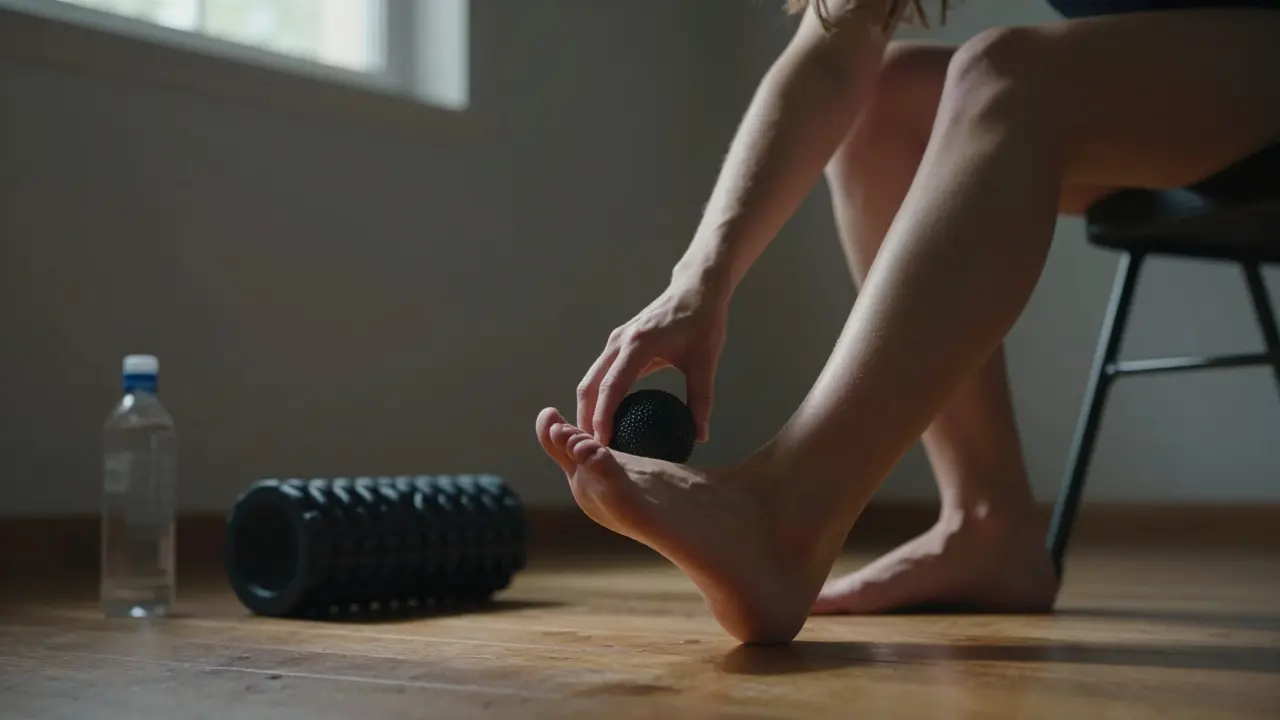
You don’t need a therapist for everything. Simple tools like foam rollers, lacrosse balls, or even a frozen water bottle can help you maintain progress between sessions.
Here’s how to do it right:
- Find the tender spot. Don’t roll over your spine or joints. Target the meaty parts of muscles.
- Place the tool under the area and slowly roll until you find a tight knot.
- When you hit it, stop. Hold. Breathe. Don’t bounce.
- Stay on that spot for 60-90 seconds. If the pain fades, move slightly to find another tight spot.
- Repeat 2-3 times per area, 3-4 times a week.
Common spots to target: calves, IT band, upper back, hips, and the bottom of your feet. Avoid rolling your lower back directly-use a tennis ball against a wall instead.
Don’t expect instant results. Like stretching, this works cumulatively. One session won’t fix years of tension. But after two weeks of consistent work, most people notice less stiffness in the morning and fewer random aches.
What to expect after a session
Right after a myofascial release session, you might feel:
- Deep soreness-like you ran a marathon
- Temporary fatigue or dizziness (it’s a nervous system reset)
- Increased range of motion
- Emotional release (some people cry-fascia holds trauma)
These are normal. Drink water. Move gently. Don’t go straight into a heavy workout. Your body is recalibrating.
Some people feel better immediately. Others feel worse for 24-48 hours. That’s called a healing reaction. It means your body is processing released tension. If pain lasts longer than two days, talk to your therapist. You might need to adjust pressure or frequency.
When not to try myofascial release
This therapy is safe for most people, but skip it if you have:
- Open wounds or recent surgery (wait at least 6 weeks)
- Blood clots or severe osteoporosis
- Advanced diabetes with neuropathy
- Active cancer or tumors in the area
- Severe inflammation from conditions like rheumatoid arthritis
Always check with your doctor if you’re unsure. Myofascial release isn’t a cure-all, but it’s a powerful tool when used correctly.
How to find a qualified therapist
Not every massage therapist knows myofascial release. Look for someone with specific training:
- Certification in John Barnes Myofascial Release (the gold standard)
- Background in physical therapy or osteopathy
- Experience treating your specific condition
A good therapist will ask about your full history-not just your pain. They’ll explain what they’re doing and why. If they just start rubbing without talking, walk out.
In New Zealand, clinics in Wellington, Auckland, and Christchurch often have specialists. Ask if they use the term "sustained pressure" and "fascial restrictions." If they say "deep tissue" or "kneading," they’re probably not doing true myofascial release.
What to expect in your first session
Your first visit lasts 60-75 minutes. You’ll talk through your pain history, movement patterns, and lifestyle. The therapist will do a postural assessment-watching how you stand, walk, sit. Then you’ll lie on a table, usually in underwear or loose clothing. No oil. No music. Just quiet pressure.
They’ll start with your feet, then move up your legs, pelvis, spine, and shoulders. You might not feel much at first. That’s okay. Fascia releases slowly. The real work happens in the quiet holds.
Most people need 4-8 sessions, once or twice a week, to see lasting change. After that, monthly maintenance keeps things moving.
Why this works when other treatments fail
Physical therapy often focuses on strengthening weak muscles. Chiropractic adjusts bones. Massage relaxes muscles. But if the fascia is stuck, none of those fix the root cause. Myofascial release goes deeper. It doesn’t just treat symptoms-it rewires how your body moves and feels.
One study followed 87 people with chronic neck pain for six months. Half got standard physiotherapy. The other half got myofascial release. The myofascial group had 58% less pain after six months. The physio group? Only 19%. The difference wasn’t strength-it was freedom.
Your body isn’t broken. It’s just stuck. Myofascial release helps you untangle it.
Is myofascial release therapy the same as foam rolling?
Foam rolling is a form of self-myofascial release, but it’s not the same as professional therapy. A therapist uses precise, sustained pressure based on your unique tissue restrictions. Foam rolling is general and often too brief to fully release fascia. It’s great for maintenance, but not for deep, chronic issues.
How long does it take to see results?
Some people feel better after one session, especially if their pain is recent. For chronic issues-like pain lasting over six months-it usually takes 4-6 sessions to notice real, lasting change. The key is consistency. One session a week for six weeks is more effective than six sessions in one week.
Does it hurt?
It should feel like a deep, burning ache-not sharp or stabbing. Think of it like stretching a tight muscle. If you’re screaming, the pressure is too much. A good therapist will adjust based on your feedback. You should feel release, not injury.
Can myofascial release help with stress and anxiety?
Yes. Tight fascia keeps your nervous system in fight-or-flight mode. Releasing it signals safety to your brain. Many people report feeling calmer, sleeping better, and having fewer panic attacks after consistent sessions. It’s not a replacement for therapy, but it supports mental wellness by calming the body.
How often should I get myofascial release?
For acute pain, once or twice a week for 4-6 weeks. For maintenance, once a month is enough. If you’re active (running, lifting, sitting all day), every 3-4 weeks helps prevent buildup. Listen to your body-if you feel stiff again, it’s time.
Is myofascial release covered by insurance in New Zealand?
Some private health insurers in New Zealand cover myofascial release if it’s provided by a registered physiotherapist or osteopath. Check your policy. ACC may cover it if your pain resulted from an accident. Always ask your provider for a receipt with the correct code: "Myofascial Release Therapy" or "Manual Therapy - Fascial Release."
If you’ve tried everything and still feel tight, it’s not your fault. Your body’s just holding on. Myofascial release gives it permission to let go.



About Author

Popular Posts


Shiatsu Massage: Balancing Energy Naturally