
Myofascial Release Therapy: How It Relieves Pain and Restores Mobility
Ever feel like your muscles are tight even after a good stretch? Or maybe you have that nagging ache in your lower back that just won’t quit, no matter how many times you ice it or take ibuprofen? You might be dealing with a problem that isn't actually in the muscle itself. It’s likely in the fascia, the connective tissue webbing that wraps around every muscle, bone, and organ in your body. When this tissue gets stuck, inflamed, or restricted, it causes pain, limits your movement, and creates a domino effect of discomfort throughout your entire system. This is where myofascial release therapy comes in.
Myofascial release (MFR) is a hands-on technique used by physical therapists, massage therapists, and chiropractors to eliminate pain and restore motion. Unlike a traditional Swedish massage that focuses on relaxing the muscle belly, MFR targets the fascia. Think of fascia like a wetsuit worn under your skin. If that wetsuit gets twisted, knotted, or shrunk in the wash, it restricts your movement and pulls on everything underneath. Myofascial release therapy works to untwist, soften, and lengthen that restrictive tissue so your body can move freely again.
Understanding the Fascia System
To get why MFR works, you first need to understand what fascia actually does. For decades, doctors thought of fascia as just inert packing material-stuffing that kept organs in place. We now know that is completely wrong. Fascia is a dynamic, living tissue packed with nerve endings. In fact, some researchers argue there are more sensory receptors in your fascia than in your muscles themselves. This means when your fascia is irritated, it sends massive pain signals to your brain.
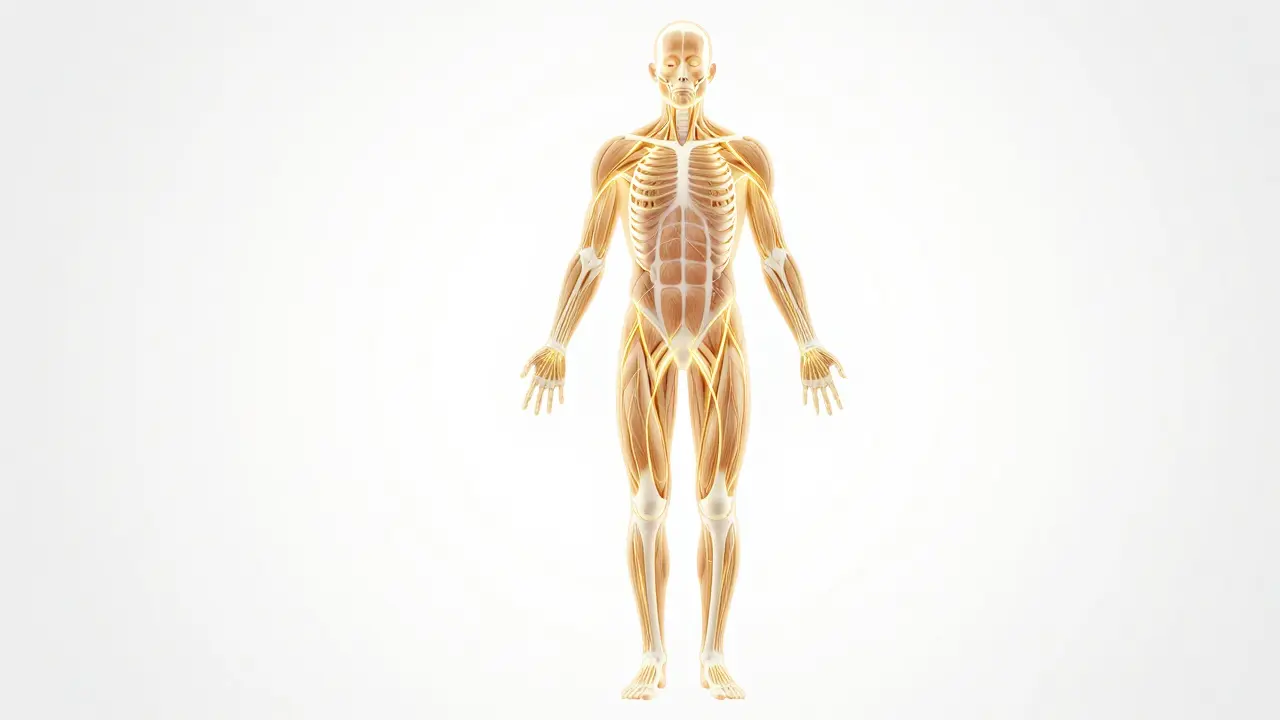
The fascia forms a continuous network from head to toe. It doesn't stop at your shoulders or your hips; it connects your jaw to your feet. This continuity explains why a problem in one area can cause pain elsewhere. A common example is plantar fasciitis in the foot causing knee pain, which then leads to hip tightness and eventually lower back issues. Because the fascia is interconnected, treating only the painful spot often fails. You have to treat the whole chain. This concept is central to understanding why myofascial release therapy requires a holistic approach rather than a localized fix.
When fascia is healthy, it is hydrated, pliable, and slippery. The layers glide smoothly over each other. But when it becomes dehydrated or injured, collagen fibers cross-link and stick together. Imagine two pieces of glass sliding over each other versus two pieces of sandpaper rubbing together. That friction is what feels like stiffness or sharp pain. MFR aims to rehydrate that tissue and break those cross-links, returning the fascia to its smooth, sliding state.
How Myofascial Release Therapy Works
The mechanics of MFR are distinct from deep tissue massage. Deep tissue massage uses short strokes and high pressure to break up knots in the muscle belly. MFR, on the other hand, uses long, sustained stretches applied directly into the restriction. A therapist will apply gentle but firm pressure into the fascia and hold it there for three to five minutes. Yes, five minutes. This duration is critical because fascia has a viscoelastic property, meaning it responds to time as much as force.
During this hold, the therapist monitors the tissue's response. They aren't trying to force it open; they are inviting it to relax. As the fascia warms up and hydrates, it begins to yield. The therapist might adjust their angle slightly to follow the path of least resistance. This process encourages the fibroblasts-the cells responsible for producing collagen-to reorganize the tissue structure. Over time, repeated sessions can remodel the fascia, making it more resilient and less prone to future restrictions.
You don't always need a professional to perform MFR, although they are best for complex cases. Self-myofascial release (SMR) is a popular alternative using tools like foam rollers, lacrosse balls, and massage guns. While these tools provide compression, they mimic the pressure aspect of MFR. However, true MFR involves stretching the tissue, which is harder to do alone. Using a foam roller against a wall or doorframe allows you to create that necessary stretch while applying pressure, bridging the gap between self-care and professional therapy.

Who Benefits from Myofascial Release?
MFR is not just for athletes who push their bodies to the limit. Anyone who sits for long periods, experiences stress, or has suffered an injury can benefit. Let's look at some specific scenarios where MFR shines.
- Chronic Back Pain: Many people with chronic low back pain have tight thoracic fascia (upper back) and hip flexors. Releasing these areas can decompress the spine without needing spinal manipulation.
- Repetitive Strain Injuries: Carpal tunnel syndrome, tennis elbow, and golfer's elbow often involve fascial restrictions in the forearm and shoulder girdle. MFR can reduce pressure on nerves and improve blood flow to the affected area.
- Post-Surgical Scarring: Scar tissue is dense, unorganized fascia. After surgeries like C-sections, knee replacements, or mastectomies, scar tissue can bind layers of tissue together, limiting movement. MFR helps break down adhesions and restore mobility in the surgical site.
- Headaches and Migraines: Tension headaches often originate in the suboccipital muscles at the base of the skull and the temporal fascia around the temples. Releasing these areas can significantly reduce headache frequency and intensity.
- Postural Issues: Slouching at a desk all day causes the chest fascia to tighten and the upper back to round out. MFR opens up the anterior chest and strengthens the posterior chain, helping you stand taller naturally.
If you find yourself constantly stiff, sore, or limited in your range of motion, your fascia might be the culprit. Identifying these patterns early can prevent minor tightness from becoming chronic pain.
What to Expect During a Session
Your first session with a myofascial release specialist will likely start with a consultation. They will ask about your medical history, current pain levels, and goals. Then, they’ll assess your posture and range of motion. You might notice they check your gait (how you walk) or ask you to bend forward to see where your spine curves. This assessment helps them map out the fascial chains that are restricting you.
Once the treatment begins, you’ll lie fully clothed on a table. The therapist will use their hands, elbows, or forearms to apply pressure. It shouldn't be excruciatingly painful, but it will feel intense. You might experience a "good hurt"-a sensation of deep stretching or releasing. Some people report feeling heat, tingling, or even emotional releases during the session. Since fascia holds onto trauma and stress, letting go physically can sometimes trigger emotional responses. This is normal and part of the healing process.
After the session, you might feel tired or sore, similar to how you feel after a hard workout. This is called post-treatment sensitivity. Drink plenty of water to help flush out metabolic waste products released from the tissues. Your therapist will likely give you homework-specific stretches or self-massage techniques to maintain the progress made during the session. Consistency is key. One session provides temporary relief, but regular sessions combined with home care lead to lasting change.
| Feature | Myofascial Release (MFR) | Deep Tissue Massage |
|---|---|---|
| Target Tissue | Fascia (connective tissue) | Muscle belly and tendons |
| Pressure Type | Gentle, sustained stretch | High pressure, short strokes |
| Duration of Hold | 3-5 minutes per restriction | Seconds to minutes |
| Pain Level | Mild to moderate discomfort | Often painful |
| Primary Goal | Restore tissue elasticity and hydration | Break up muscle knots and adhesions |

Self-Myofascial Release Techniques
You can incorporate MFR principles into your daily routine with simple tools. Here are three effective techniques you can try at home.
- Thoracic Spine Extension: Place a foam roller horizontally across your upper back. Support your head with your hands and gently lean back over the roller. Roll slowly up and down your mid-back, avoiding the lower spine. This opens up the chest and counteracts slouching.
- Glute Release with Lacrosse Ball: Sit on a lacrosse ball placed on your buttock. Cross the leg of the side you're working over the opposite knee (figure-four position). Lean into the ball until you find a tender spot. Hold for 60-90 seconds until the tension decreases. This relieves sciatic nerve irritation and hip tightness.
- Calf Decompression: Stand facing a wall. Place one foot behind you with the heel down and toes pointing forward. Lean into the wall, keeping the back leg straight, to stretch the gastrocnemius. Then, bend the back knee slightly while keeping the heel down to stretch the soleus. Hold each position for 30 seconds. This breaks up calf fascia restrictions.
Remember, consistency beats intensity. Doing these exercises for 10 minutes a day is far more effective than doing them for an hour once a week. Listen to your body. If something hurts sharply, stop. Discomfort is okay; pain is not.
Finding the Right Practitioner
Not all massage therapists are trained in myofascial release. Look for practitioners with certifications in John Barnes Myofascial Release, Rolfing Structural Integration, or Clinical Myofascial Release. Physical therapists often have extensive training in MFR due to its clinical applications. When booking, ask about their experience with your specific condition. A good practitioner will explain their approach and set realistic expectations for your recovery timeline.
In Perth, Australia, many clinics integrate MFR into broader rehabilitation programs. Whether you're recovering from a surfing injury or dealing with office-related neck pain, finding a specialist who understands fascial anatomy can make the difference between temporary relief and long-term health. Don't hesitate to ask questions during your initial consultation. You should feel comfortable and informed throughout the process.
Does myofascial release therapy hurt?
It can be uncomfortable, but it should not be excruciating. MFR uses gentle, sustained pressure rather than aggressive kneading. You may feel a deep stretching sensation or mild soreness afterward, similar to post-workout fatigue. If you experience sharp pain, communicate this to your therapist immediately so they can adjust their technique.
How many sessions do I need?
The number of sessions depends on the severity and chronicity of your condition. Acute issues may resolve in 1-3 sessions, while chronic problems like long-standing back pain or post-surgical scarring might require 6-10 sessions or more. Regular maintenance sessions every 4-6 weeks can help prevent recurrence.
Can I do myofascial release at home?
Yes, self-myofascial release (SMR) is highly effective for maintenance. Tools like foam rollers, massage balls, and percussion devices can help manage tension. However, SMR is most effective when combined with professional therapy, especially for complex restrictions or injuries. Always learn proper technique to avoid injuring yourself.
Is myofascial release safe for everyone?
Generally, yes. However, people with certain conditions like osteoporosis, blood clots, acute inflammation, or cancer should consult their doctor before starting MFR. Pregnant women should also seek guidance from a qualified prenatal therapist. Always disclose your medical history to your practitioner.
How is myofascial release different from trigger point therapy?
Trigger point therapy focuses on specific knots within the muscle belly, using direct pressure to release them. Myofascial release targets the broader fascial network, using sustained stretching to improve tissue elasticity and hydration. While both address pain, MFR takes a more systemic approach, recognizing that fascia connects the entire body.



About Author